The Last Line of Code
After two years of working with AI tools and large language models, I feel like the time of writing my last line of code is coming soon. I do not say that with fear. I say it with optimism.
Over the past year, I have noticed something interesting: I am writing less and less code myself. AI writes more and more of it. What started as small help—generating utility functions, fixing syntax, suggesting refactors—has quietly grown into something much bigger. Today, entire modules, workflows, and architectural scaffolding can be produced from a well-structured prompt. Increasingly, my role is no longer typing the code, but defining what should be built and why.
For most of my career, writing software meant translating ideas into code line by line. We designed systems, broke problems into components, selected frameworks, wrote functions, debugged edge cases, and slowly turned abstract intent into executable logic. Code was the bridge between human thought and machine action.
But that bridge is changing. Increasingly, the most important work is no longer the act of typing code itself. It is the act of defining the problem clearly, describing the desired behavior precisely, understanding the tradeoffs, and giving the machine enough structured intent to generate the implementation.
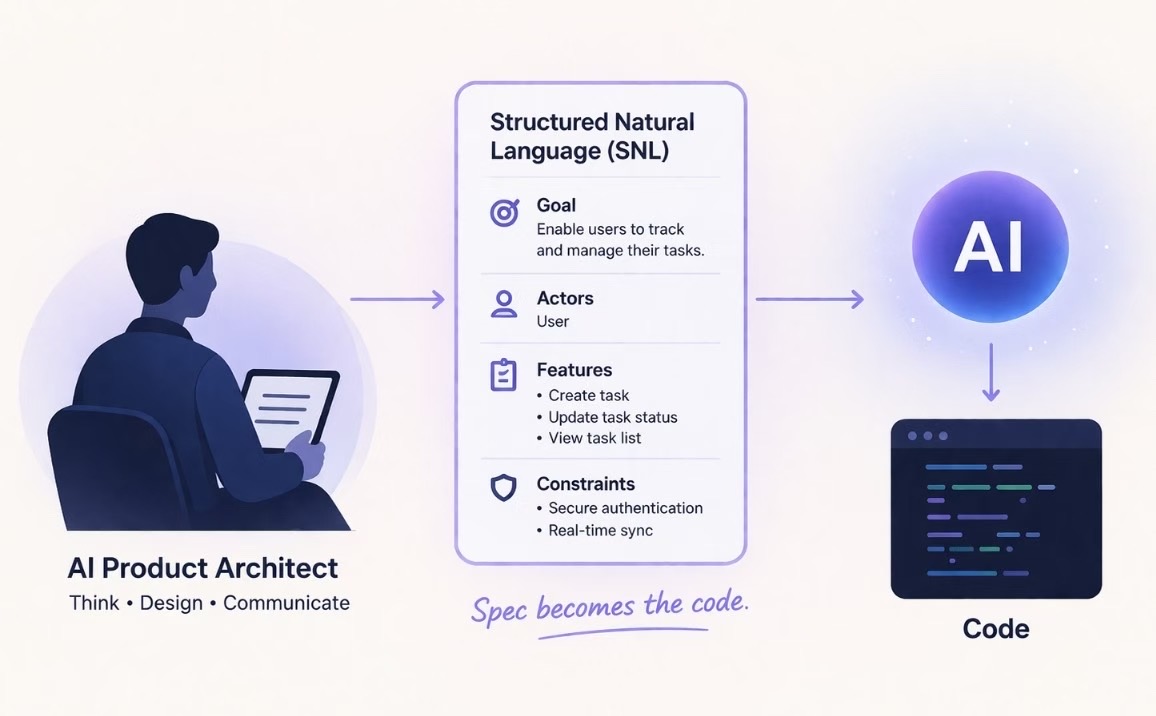
The spec becomes the code. The engineer becomes the architect.
The First Great Leap
We have seen this pattern before. The jump from assembly language to high-level languages like C was one of the great turning points in software history. Engineers stopped thinking primarily in machine instructions and started thinking in human logic: variables, loops, functions, data structures, and systems.
That shift did not eliminate engineering. It elevated it. Programmers no longer had to manage every tiny machine-level detail by hand. They could focus on larger structures, better abstractions, and more ambitious applications.
At the time, some people probably worried that higher-level languages made programmers less connected to the machine. In reality, they made software development more powerful. They allowed more people to build more complex systems faster.
Today, we are approaching another leap. This one may be even bigger.
The Second Leap: From Code to Intent
Engineers are already using AI to generate code from conversational prompts. A developer can describe a function, request a class, ask for a database schema, or generate a user interface from a short paragraph. This already changes the daily rhythm of programming.
But free-form prompting is only the beginning. Prompting alone is often too loose, too ambiguous, and too dependent on the model guessing what we mean. It works for prototypes, examples, and small tasks, but serious software requires more discipline.
What I see emerging is something I call Structured Natural Language, or SNL. It is more than prompting, and it is more disciplined than ordinary conversation. SNL sits between traditional programming languages and free-form human language—a structured way of expressing requirements, workflows, rules, constraints, and system behavior so precisely that AI can reliably turn it into working software.
In this world, engineers do not begin by writing functions. They begin by writing structured specifications. They define what the system should do, how users interact with it, what data is required, what exceptions must be handled, what security rules apply, and how success should be tested.
The AI then turns that structured intent into code.
The Spec Becomes the Source
In traditional development, a specification is often treated as a document that sits outside the code. It is written, reviewed, and then gradually becomes outdated as the implementation changes.
In the AI-driven development model, the specification becomes much more central. It may become the true source of the system. Code becomes an output, not the starting point.
This changes the role of the engineer. The engineer is no longer simply a person who writes instructions for the computer. The engineer becomes the person who defines intent, architecture, behavior, constraints, and quality standards clearly enough that an AI system can produce and maintain the implementation.
This does not mean engineering becomes easier. In many ways, it becomes more demanding. Vague thinking will produce vague software. Weak requirements will produce weak systems. Poor architecture will still fail, even if the code is generated perfectly.
The difference is where the value moves. The value moves upward from syntax to structure, from implementation to intention, from typing to thinking.
The Rise of the AI Product Architect
If SNL becomes the new interface between humans and software, then the role of the engineer changes with it. The person creating value is no longer the one typing the most code, but the one who can define the system most clearly.
This shift gives rise to a new role: the AI Product Architect, or APA.
The AI Product Architect is a hybrid of product manager, solution architect, systems designer, and technical strategist. This person understands the user need, the business goal, the system architecture, the data model, the workflow, and the limits of AI-generated implementation.
The APA does not merely ask AI to “build an app.” The APA defines the app with enough precision that AI can build it correctly. That includes describing screens, data objects, permissions, edge cases, integrations, validation rules, error handling, testing expectations, and deployment assumptions.
In other words, the APA turns messy human desire into structured machine-executable intent.
The New Question
For decades, the question for software engineers was: Can you code?
That question will not disappear immediately. There will still be systems where deep coding skill matters. There will still be infrastructure, performance-critical software, embedded systems, security-sensitive applications, and specialized domains where human-written code remains essential.
But for a growing portion of business software, internal tools, web applications, automation systems, AI agents, and workflow platforms, the more important question will become:
Can you think, design, and communicate intent with precision?
That is a very different skill set. It rewards clarity. It rewards systems thinking. It rewards product judgment. It rewards the ability to anticipate ambiguity before it becomes a bug.
The engineer of tomorrow may spend less time writing code and more time writing structured requirements, reviewing AI-generated implementations, designing architecture, defining test cases, validating behavior, and improving the feedback loop between human intent and machine output.
This Is Not the End of Engineering
Saying that engineers may stop writing code does not mean engineers disappear. It means the center of engineering moves.
A good engineer was never valuable only because they knew syntax. Syntax was simply the language of the time. The deeper value was always problem solving, abstraction, judgment, architecture, and the ability to build reliable systems from incomplete information.
AI does not remove that need. It increases it.
When code becomes easier to generate, the bottleneck shifts to knowing what should be built, why it should be built, how it should behave, and how to know when it is correct. That is not a smaller role. That is a higher-level role.
The Risk of Standing Still
Like any major transition, this shift will not happen evenly. Not every company will adopt it at the same speed. Not every domain will be safe for full AI-generated implementation. Not every developer will need to change overnight.
But the direction is clear. The momentum is undeniable.
For every software engineer, the choice is becoming simple: evolve into the AI Product Architect of tomorrow, or risk being replaced by someone who does.
That may sound harsh, but I do not see it as a threat. I see it as an invitation. We are being invited to move up the ladder of abstraction again. Just as engineers once moved from assembly to C, from C to higher-level languages, from servers to cloud platforms, and from manual deployment to DevOps automation, we are now moving from code to intent.
My Last Line of Code
I do not know exactly when I will write my last line of code. Maybe it will not be a dramatic moment. Maybe I will not even notice it when it happens. One day, I may simply realize that I spend most of my time designing systems, writing structured specifications, guiding AI agents, reviewing generated output, and improving architecture — while the code itself is produced somewhere downstream.
And when that day comes, I do not think I will feel like I lost something.
I think I will feel like software engineering has finally moved closer to where it was always trying to go: from machine instruction to human intention.
The last line of code is not the end of building. It is the beginning of building at a higher level.
And that naturally leads to the next question: if code becomes the output rather than the starting point, what replaces it as the primary language of engineering?
I believe that answer may be Structured Natural Language, or SNL—a disciplined way of defining systems through intent, architecture, constraints, and logic expressed in a form closer to human reasoning than traditional programming syntax.
If programming languages were the source code of the software era, SNL may become the source code of the AI era. That is the next idea I want to explore.